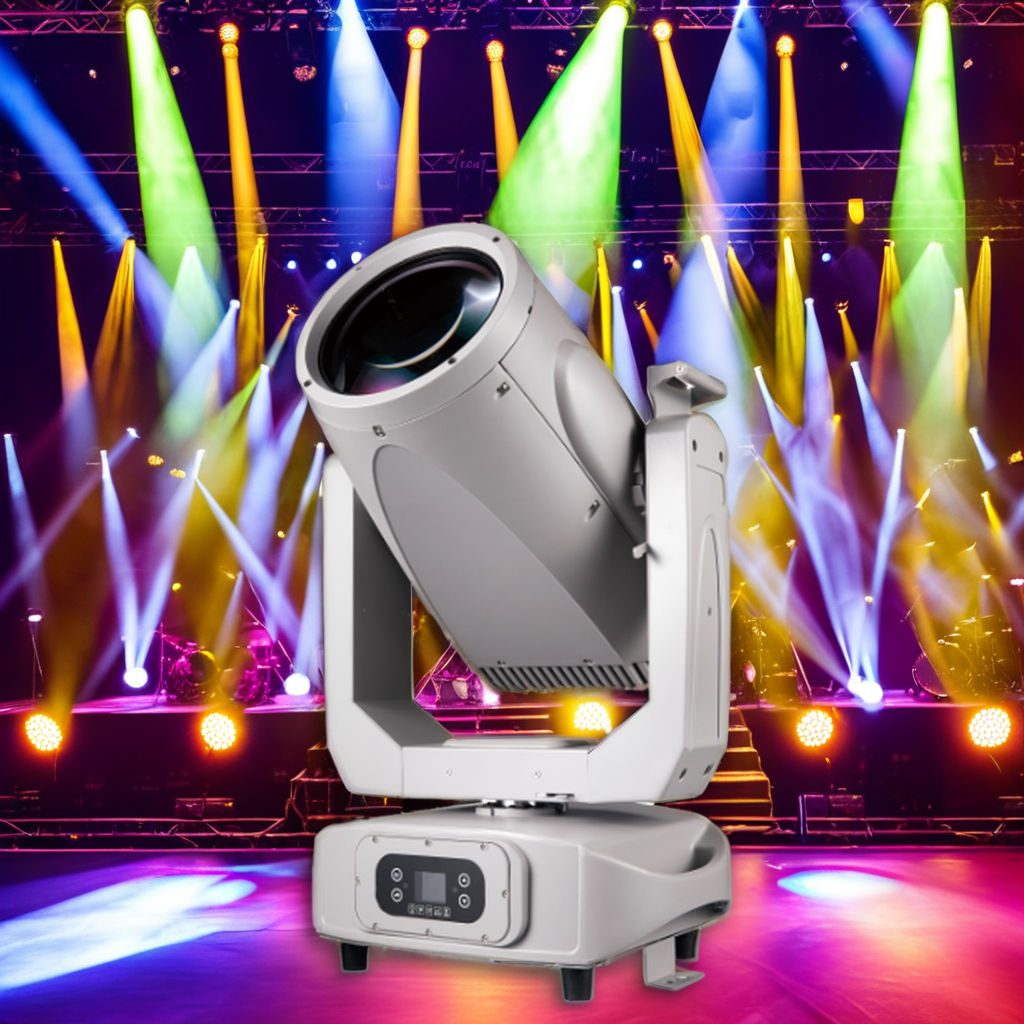
Outdoor rigs fail for boring reasons. Not because the beam was too wide or the colour mixing was wrong — but because water got in, connectors corroded, or the fixture had no way to report a fault until it went dark in front of an audience.
This guide walks through what actually matters when you specify weatherproof fixtures, using real specifications from our outdoor range rather than marketing adjectives.
What IP65 Actually Promises
An IP rating is two digits, and buyers routinely over-read the second one.
| Digit | Position | What it covers |
|---|---|---|
| 6 | First (solid) | Dust-tight — no ingress of dust, complete protection against contact |
| 5 | Second (liquid) | Protected against low-pressure water jets from any direction |
IP65 means the enclosure is sealed against dust and will survive rain and hose-down. It does not mean the fixture can be submerged — that requires IP67 or IP68. For a festival stage that gets rained on, or a permanent install on a seafront, IP65 is the standard working rating.
One thing the rating does not cover: corrosion. A fixture can be perfectly sealed and still fail because the housing pitted through. That is a separate specification, and we come back to it below.
The Five Things Worth Checking
1. Beam angle and zoom range
This decides what the fixture is for, and it is the single most common mismatch we see in enquiries.
- 2°–5° — a true beam look, tight aerial shafts. This is the SL-IP-B400's range.
- 5°–55° — a wash that can also punch. Wide zoom ratio, one fixture covers both front wash and mid-air work.
- 2°–45° — hybrid territory. Broad enough to be useful, tight enough to be dramatic.
If your design needs both hard beams and even stage wash, one hybrid fixture often beats two specialised ones once you count rigging time and cabling.
2. Control protocol
DMX512 is the baseline. The upgrade worth paying for is RDM (Remote Device Management), which lets the console discover fixtures, set addresses and read fault status remotely — instead of sending someone up a truss with a ladder.
| Model | Control protocols |
|---|---|
| SL-IP-B400 | DMX512 / RDM |
| SL-IP-W400 | DMX512 / RDM |
| SL-IP-H600 | DMX512 / RDM / Art-Net |
| SL-BPAR | DMX512 / Wireless DMX |
| SL-PW-CITY | DMX512 / RDM / Auto / Master-Slave |
Art-Net on the SL-IP-H600 matters if you are running pixel-mapped or large-channel-count rigs over network infrastructure rather than copper DMX runs.
3. Colour system
- Colour wheel (SL-IP-B400) — fast, punchy, saturated. Good for beam work where you want instant hard colour changes.
- RGBW / CTO (SL-IP-W400) — smooth mixing plus tungsten correction. The practical choice for washing skin tones on camera.
- CMY / CTO (SL-IP-H600) — subtractive mixing, the widest usable colour gamut, and the standard for broadcast and theatre.
4. Weight and rigging
Our outdoor moving heads sit in the 15–24 kg band depending on configuration. That is relevant twice: when you calculate truss loading, and when you calculate how many fixtures two crew can hang in an hour. The SL-PW-CITY city-colour unit is heavier at 18.5 kg.
Every moving head in the range gives you 540° pan / 270° tilt at 16-bit resolution, with 0–100% linear 16-bit dimming — so slow fades stay smooth instead of stepping at the bottom of the curve.
5. Coastal and seaside installations
This is where most weatherproof specifications fall short, and it is worth being blunt about it: an IP rating tells you nothing about salt.
Salt-laden air attacks aluminium housings and connectors. If your venue is within a few hundred metres of the sea, ask specifically about salt-spray testing rather than relying on the IP number. Our SL-PW-CITY uses a die-cast aluminium housing that is salt-spray tested, which is why it is specified for permanent architectural and seafront work rather than touring.
For touring fixtures that will only occasionally see coastal air, the practical mitigations are rinse-downs with fresh water after exposure and dielectric grease on connectors.
Power and Logistics
Every fixture in the outdoor range runs on AC 100–240V, 50/60Hz — so the same inventory ships to Europe, North America and Asia without transformer planning. Worth confirming your distribution is rated for the draw: the SL-PW-CITY pulls up to 960 W at full output.
Warranty is 3 years (limited) across the moving head range, and 2 years (limited) on the SL-PW-CITY.
What Ships in the Box
Each unit goes through a 48-hour burn-in before it leaves the factory, and ships with an individual QC report, IES/LDT photometric files and a DMX channel chart. The photometric files are the part worth planning around — your team can pre-visualise the rig before the truck arrives, instead of discovering coverage problems during load-in.
Quick Selection Guide
| If you need | Look at |
|---|---|
| Tight aerial beams, festival main stage | SL-IP-B400 (400W, 2°–5°, IP65) |
| One fixture for wash and mid-air work | SL-IP-W400 (400W, 5°–55° zoom, RGBW/CTO) |
| Maximum flexibility, network control | SL-IP-H600 (600W, 2°–45°, CMY, Art-Net) |
| Cable-free uplighting, fast setup | SL-BPAR (100W battery, wireless DMX, IP65) |
| Permanent architectural / seafront | SL-PW-CITY (96×10W RGBW, salt-spray tested) |
Next Step
The fastest way to a usable specification is to tell us the venue type, throw distance and whether the install is touring or permanent. We will come back with a fixture count, photometric files and a quote — no obligation.
Request a quote with your venue details, or ask our assistant on any product page for specification details.
Need help choosing fixtures for your project? Tell us the venue type and room size — we'll spec it for free.
Request a Free Rig Spec →